
After I had been reading Human kind (2020) , and talking about it alot, I invited Teresa Driver from the Annexe and Dyke House Big Local in Hartlepool, to share some of her experiences of what life and work has been like as a community worker in the Dyke House area of Hartlepool, the north east of England.
I was keen to find out from her, what had been revealed about the kindness of people during the last few months:
Here in Dyke House the people are great, they look out for each other. During this pandemic I have witnessed and heard of so, so many acts of kindness. I am not surprised though, people around here did not need a pandemic to express their kindness, they demonstrate it everyday.
In a community like ours people are used to handling a crisis as they experience them on a weekly basis. But, they get on with it. They look out for each other. People share their food, go to the shops for their neighbours, support local events and organise day trips.
When the bingo hall closed for lockdown 2020 we organised an online bingo session. The 2nd bingo session was led by a resident and it went from strength to strength. We do not occupy the space anymore, we don’t need to, residents have organised

We’ve all sewn 900 sunflower plants out there! People will have them in their gardens and they will look beautiful. This community will shine. Lots of children and young adults have been growing vegetables for the first time and we have had some lovely images sent to us.

We get food donated that is destined for landfill. We have been putting it outside on tables so people can choose what they take. We said to them, if you touch it take it, be kind and stay the journey. You always will get one or two people who appear to be taking too much, too often, but a conversation with these people or a light challenge from a resident normally resolves this. But it’s one or two out of hundreds per week.

One resident in a vulnerable group rang as they had a rash but did not have the digital equipment needed to do what the GP was asking. I called on a resident, who at a safe distance, over the garden fence, held her breath and took a photo. The photo was sent to me and I forwarded it to the GP. The rash was treated!
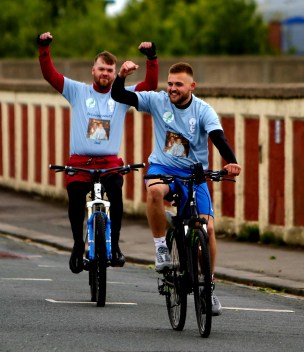
Adam Garrinton and Callum Atter rode 32 miles from Newcastle Football ground to Victoria Park, Hartlepool to raise funds for a local group Minds for Men, a new project in Hartlepool. Adam wanted so much to do this after losing his dad back in 2012. Total raised of a £350 target is £1,680.
I think that where we have seen new acts of kindness in communities we sustain it by celebrating it. We talk about what was good and what is what it feels like to be good to others. People love helping people. Kindness will win over this virus.
Be kind. Always.
I am so grateful to Teresa for sharing these stories. Because, the best thing about these examples? They’re repeated all over the place, or at least they can be, and the many 1000 that occur often go unnoticed. But they happen.
They happen because being kind is more close to what most people are actually like.
Yet, it’s as if there’s a kindness fatigue, or amnesia. So normal they’re not newsworthy, its easier to focus on the absurdly awful. When it comes down to it, were more normally kind than we think we are.
Kindness has been revealed in the virus, its far easier to be kind, how might it catch on and become contagious? But kindness and human cooperation and goodness is already there… maybe we just haven’t seen it as well until now.
What do you think?
Why not spread and share the love and tell your story of kindness below in the comments? I’d love to share them in another piece next week.
Many Thanks to Teresa from the Annexe and Dyke House Big Local, you can see more of the work of the Wharton Trust at This link and her details are there.
For more on Human Kind, by Rutger Bregman (2020) do view my previous pieces, and part 2 of my series on The Theology of Human-kind ness will be published on Monday.


 Learning from the Streets
Leave a reply to christellelerryn Cancel reply