I’m barely jumping on a bandwagon here, but maybe quietly over the last 4 weeks, 6 million copies of a non fiction book have been sold across the globe. If it wasn’t for the vast amount of literature written by black authors it would sit high in the NYT best seller list. And when you get to ride trains again it will be up there on the WHSmith shelves.
And that Book is HUMANKIND, by Rutger Bregman (2020)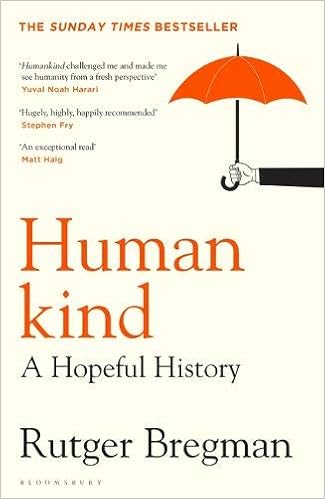
And I have so far written four pieces on it. I’m clearly a fan.
As well as how it describes, deconstructs, predominant psychology, media and sociology on the nature of Humanity, he has much to say that needs to be considered from a theological basis, that I believe we need to take seriously, and certainly, not as some might do, instantly reject. This post will look at the sections in the book that demand considerable reflection in light of the biblical text and view of ourselves.
Bregman opens with the thesis of a view of human kind that is legitimised by every branch of science, but ignored by religions and ideologies, the news media and erased from the annals of world history.
That most people, deep down, are pretty decent (p2)
On page 17, Bregman writes that a negative view of humanity, (that humans are innately selfish) has a hallowed tradition, from Nietzche, Freud, Hobbes and others, all had a view of humanity that was steeped in a veneer theory that when scratched underneath the surface we are all selfish.
This view is also permeated by early days, writes Bregman, Augustines view of Original Sin ; ‘No one is free from Sin’ he wrote ; ‘not even an infant whose span of earthly life is but a single day’ (Bregman, 2020, p17), and this has continued in the church, Bregman highlights the protestant catechism in 1563) which informs us all that Humans are ‘totally unable to do any good and inclined to do all evil’ (Heidelberg Catechism, 1563). Its not only the protestant, but the Orthodox too. And Bregman describes how this negative view of man is perpetuated by enlightenment figures (no doubt influenced heavily by the religious context of the day also) – that include Darwin, Machiavelli, Huxley, and maybe shockingly but not necessarily shocking for its day, Philosophist Herbert Spencer who suggested that ‘the whole effort of nature is to get rid of (the poor) to clear the world of them, to make room for better’ (Bregman 2020,18)
So – early Historic Christianity upheld a negative view of Human kind – What other aspects of the Christian faith does Bregman reflect on?
Well, actually, that’s it. Thats his one idea. It doesnt need to get bigger or more than this.
It is the principle that Humans are good.
and this is big enough, dont you think?
What he then does is provide an anthropic, historic and realistic view that this is actually the case. And where and why things have gone wrong, if humans are indeed better that we thought they were (including why we dont think humans are indeed as good as we think they are) . What Bregman does, anthropologically is also provide a view on the origins of religion within the context of the history of Man, a view that should or could have far reaching impact on how we might view the words of scripture. If we are open to it.
So these good humans.. has it always been this way ?
I’m not here going to take on creationism. And if you hold this view rigidly, you’re basically reading the wrong blog anyway. But say for arguments sake, there were a number of different Homo species on the earth, as many archaeological digs have discovered. One Species, Homo sapiens, remained, why, not because of war or fighting (there are no cave drawings of warfare) , but more, survival of the friendliest and the mimics.
For Bregman, this early group of Humanity was nomadic, survived in communities, had flat authority, shared, and communicated across ways. And this continued for 3-4000 years. (Bregman p84-96)
War does not go backwards in time, it had a beginning.
This is no summary on the history of war. But, theologically, it has to do with the emergence of the human view, and the necessity of the concept of sin. Because, at that point, a group of people, though not angelic by any means, had considerable collective decision making, processed for ostracising the lazy or bullies and working in communities to live, love and survive. By being friendly and cooperative. A snuggle, rather than struggle for survival. (not my line, but Bregmans)
Its possessions that caused changed. Land. A Land that was plentiful, notably between the Nile and Tigris, didn’t necessitate travel, but settlement. As soon as the first human said ‘this is mine’ did problems start.
Only after then did wars break out. Its when cave paintings depict war. We distrusted people outside of boundaries, and had something to fight over. Strangers banded together not cooperatively, but for war. Leaders were needed. Its this time the Bible is writing about and documenting, not the time before. Not quite, anyway.
Bregman quotes Samuel who warns the Israelites about War and accepting a king.
As Bregman remarks, its funny that the view permeates that cavemen were brutish and civilisation was the great peace enabler. It was the other way around. But history is written by the most recent?
The Fall Story, Bregman tentatively suggests, could indicate a shift in agricultural thinking and community gathering. The settled life was far harder than the nomadic one (p103) . And women were harder hit, as they were viewed as a commondity to the settled farm hand, rather than integral to the entire nomadic operation as before.
A settled life brought other frailties. Such as disease. We lived nearer our own waste. Yeah, grim. But true. Towns became Petri dishes for disease. STI’s were also now rampant. And with that came a greater desire for female virginity especially as the leader had his choice of 100’s of women.
‘Hence the idea, still upheld by millions today, that sex before marriage is a sin’ (Bregman, p104)
When things started to go wrong, it was better to have someone to blame.
And so, that’s where Gods came in. Gods were enraged by our behaviour. From foods, thoughts and behaviours all were under the microscope as reasons for disease or actions for penance.
‘For the first time in history, we developed a notion of sin’ (Bregman, p105)
Even though this new settled life was full of issues, there could be no going back. Settled groups had made barriers and so, they themselves couldn’t move or were frightened of the outsider. Trapped in their own cess pool of religious deference.
And larger groups meant communication was trickier too.
Humans had to collect around other groups that encouraged a unity and purpose, from villages of up to 1500 people on the move, to now, thousands settled. Religions, organisations had the task of communicating guidelines, morals and principles so that larger numbers of people adhered to them, adhering to invisible mythical organisations like, for example ‘the church of England’ .
Its in his chapter 11, ‘How Power corrupts’ , that Bregman highlights the use of religion and their myths as a form of communication and control. How people had to be friendly to be popular in a group to become leader, but that power corrupts them to keep them there. Its one answer to his question why have good decent people elected and chosen leaders who are often corrupt, sociopathic and damaging.
In this chapter, though, Bregman goes personal.
Describing that how as a teenager he wondered why a creator God cared about human beings and our mundane things, so intimately in what might be some kind of Big Brother, evil eye kind of way. As he went on to describe quite simply a large population in a settlement couldn’t keep an eye on each other, people needed a force that could do that for them (Bregman, p234) . The God of the bible that can count hairs.
And though prehistoric man had myths and religions, and evidence of temples that they build without the collective sacred myth that was more stable, they then were able to remove leaders who were corrupt or ostracise them, and be skeptical. But add war and weapons and it becomes much harder to oust the leader. (p237)
This one premise of Human kindness, then asks us to re look at the Bible, on the basis of not what the bible contains and its truth or otherwise, but why actually the bible and religion was needed/created in the first place. What it does is set the human context of the bible, and how the development of civilisation affected the way in which those writing the bible were affected.
But is Bregman right?
It a fascinating proposal and if we take a view that Humans a more decent and kind than we have been led to believe, then it might mean a different reading of the bible itself, and especially the aspects that consider moral behaviour.
Maybe its worth thinking, ‘ What kind of view of Humanity does the Bible have?’ and… do different writers think differently. What we do know, and have some certainty of is that Biblically we were created good, and the incarnation is an act of valuing humanity as Jesus became fully man.
I think Ill leave this for now… this was going to be one blog, but ill split it into 2 or maybe 3.. the next one will be later in the week.
What about the Human condition – might we be better than we think? and Is it Theological?
Often how surprised are churches and leaders by the kindness of others having written them off? What is going on there..
And what changes as a result…
What do you think?


 Learning from the Streets
Leave a comment