This is the second part in a series on reflecting on Human kind by Rutger Bregman, and taking note of what it might mean theologically to consider the Human condition in a more realistic way. The first part is here. In this second part, I want to look at the final chapters of Bregmans book, as if to complete a theological survey of his key themes, and develop maybe in this part, or the next will reflect on the nature of humanity as described biblically, and wonder how we got here.
Continuing the story from part one. ..
The Gods that were once needed to control large populations into acting a certain way, build temples, moral behaviour – changed since the enlightenment, according to Bregman (p245-246) as the principle controlling force in most peoples lives become the growth of the state, post enlightenment. As a result, Business was more inclusive, trade was universal. Belief in a vengeful God diminished. As Christian leaders, we might do very well to reflect on power in those leadership positions, especially where structures are manipulated to maintain power in an unhealthy way.
Few counties, says Bregman, still defer to the ruling eye of God, and The pope instead espouses ‘a revolution of tenderness’. God lost his job to baureocrats. Enlightenment was not the cosy end game however, as Bregman argues, wealth and money became de facto, and thinking within it espoused not only a sense that people were to be not trusted; Hume believing that we should act as though people have a selfish nature. It also gave rise to racsim. Something that probably only this week we are starting to reflect and dismantle in any serious way. Hopefully.
Moving on, as this isn’t a sociological essay…
Bregman pulls on significant religious metaphor in his final section. Beyond thinking about a new realism, where people are kinder that we think.
‘Turn the other cheek’ could not be a closer theological reference if it tried. Albeit, this is a concept found in most religions, like the golden rule.
If you want a number of sermon illustrations for this, then look no further. What Bregman does in these chapters is describe the pre conceived judgements organisations have on people, and then outlines other organisations who have taken a different path. To treat the worst prisoner with respect, and surprisingly it reduces reoffending rates. Schools that encourage play, creativity and individuality that have better results, and less ADHD… Its about how we believe in people.
To be kinder. We have to have contact with people. Distance breeds prejudice and fear. This has been proved with countless studies. From a theological view point, its interesting that the incarnation is about human contact with God, and vice versa… God was one of us. It’s fascinating. At a time when civilisations we’re on the verge of a new way of being, humanity needed a new way of relating to God. One that befit their new settled status. One that reviewed the old laws. One that was different. There is more to say.
There are a few more references with the book in which Bregman draws on principles from Christianity, and using them in a way which constructs a new way of thinking and being, one that befits the kind of humans we actually are. 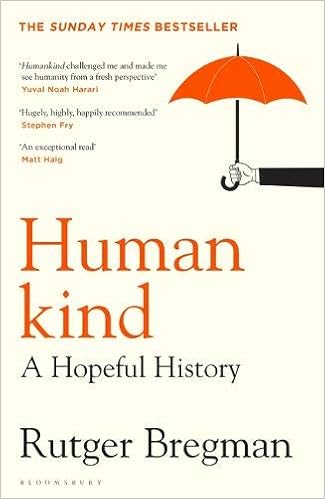
He doesnt duck the question about what about bad people, and what causes these things, from German fighters in the wars, to terrorists and racists.. as well as those who vote in ways that might seem at odds with common sense.. most people, he says, have to believe that what they are doing is for good, even if it is in fact an evil act. No one objectively steals, but if its a loaf of bread to feed their family. And this is in the book of proverbs.
It is a compelling argument.
What surprises me is that this seems so alien. So unreal to anything that been taught. But that doesnt make it wrong. The actual real evidence is all around us, its that we’ve have been trained or blinded not to look. Kids and families play with their dogs on the beach and its fabulous and they make rainbows and have got on with homeschooling, people volunteer, support each other, people are friends and help each other through personal challenges, we do all these things, quite naturally, because actually we’re good people. but people being good doesnt make good TV, unless its framed by a charity telethon, or its DIY SOS and it makes people cry. But DIY SOS happens all the time. We are more communal than we think. Its only the one story of crime that makes us rethink. Because…. it’s so unusual, and it’s newsworthy.
So. What about the Human Condition and Faith?
That’s for part 3.
This is the filling part two of the trilogy. Its the journey from Ravendell to the two towers where nothing much happens.
Maybe its time to think about – How much of the activities of our churches, how much is geared around a negative view of humanity?
and where does this come from, and what is lost if this changes?
One where – ‘we have to save them’ – that ‘they’ are ‘all’ _________
And think, as I said in part 1, about Sin, and also Shame, and how this is used to manipulate, engender behaviour, that is codependant and humiliates in the face of damaging and unhealthy leaders. Some of what is written, especially to young people, is so damaging, and permeates such an unhealthy view of them as a person, that is harmful. Its so bad that when anyone actually talks to and with a young person and gives them respect, then they’re surprised. Because that’s closer the reality.
Theres as many, if not more rainbows and banners supporting the NHS in the ‘so called’ poor estates of the north east. No one has the monotony on goodness and kindness. The challenge is that Bregman places the finger at the rich, the aloof, the distant, the leaders, and suggests that its from this place of privilege and powerful entitlement (whether media or politician) that irresponsibility, sociopathy and narcissism lay. Where they couldn’t believe that people can be good. How much in the church, is then geared around a ‘them’ and ‘us’ where we expect so little of others, and treat people as a number or a project.
You don’t need me to repeat what I’ve said before. And even if we think we are treating people well, Bregmans examples highlight ways that we can do even better.
But as Bregman encourages. Its actually the reality. Its time to believe in actually what we see with our eyes, when our eyes aren’t on a TV screen.
His book is about ‘A Hopeful History’ and, whilst it expands a look at humanity that might not be perpetuated in the Bible, it probably is there if we look for it. And, if nothing else, it means that we can be hopeful in our humanity, less cynical, and be more assured. As christians we can be doubly hopeful. It’s both. Hopeful that Humans are better than we think, and it takes work continually trying to convince ourselves that we’re not, or act like that, and also that Hope, Love, Charity, Goodness and kindness are closer to our core. Closer to the real us, closer to the people we are made to be.
People are better that we think, people are good, and decent most of the time, Crisis times confirm it, and the poorest are in crisis all the time.
I remember as a detached youthworker going to the local skatepark. The oldest young person there saw us, checked us out, and then gave us a tour, who was who, who did what, and how they all self regulated and looked after the place, how they carried each other to ambulances and went to hospitals after accidents. Its amazing what communities of people do. Supporting each other after being treated appallingly by the police who had no contact with them. Why was I surprised at the depth of cooperation of this groups of young peopler? had I read Lord of the flies? no, but its easier to be convinced that other people aren’t good to make us feel better, and yet in reality.. And this story is everywhere.
So, that’s it for a short ish part two.
Part 3 next week:


 Learning from the Streets
Leave a comment