For those of you who are interested here is a summary of the sermon that I preached this morning at St Aidans Church, Chilton, County Durham, as part of poverty Sunday: (and yes it was a bit longer than 7 minutes)
Good morning all, today we are going to look at poverty, and thank you for inviting me to share with you, I hope to bring to you stories from a variety of perspectives to help us look at poverty.
The first is a short quote from Darren McGarvey, Darren was brought up in Pollok, Glasgow, not quite Easterhouse, but still, an area of Glasgow renowned for significant challenges. In his award winning book, he says the following:
(poverty) ‘Its the belief that the system is rigged against you, and that all attempts to resist or challenge it are futile. That the decisions that affect your life are being taken by a bunch of other people somewhere else who are deliberately trying to conceal things from you. A belief that you are excluded from taking part in the conversation about your own life. This belief is deeply held in many communities and there is a good reason for it. Its true’ (Poverty Safari, p37)
Another quote, Gustavo Gutierrez says the following
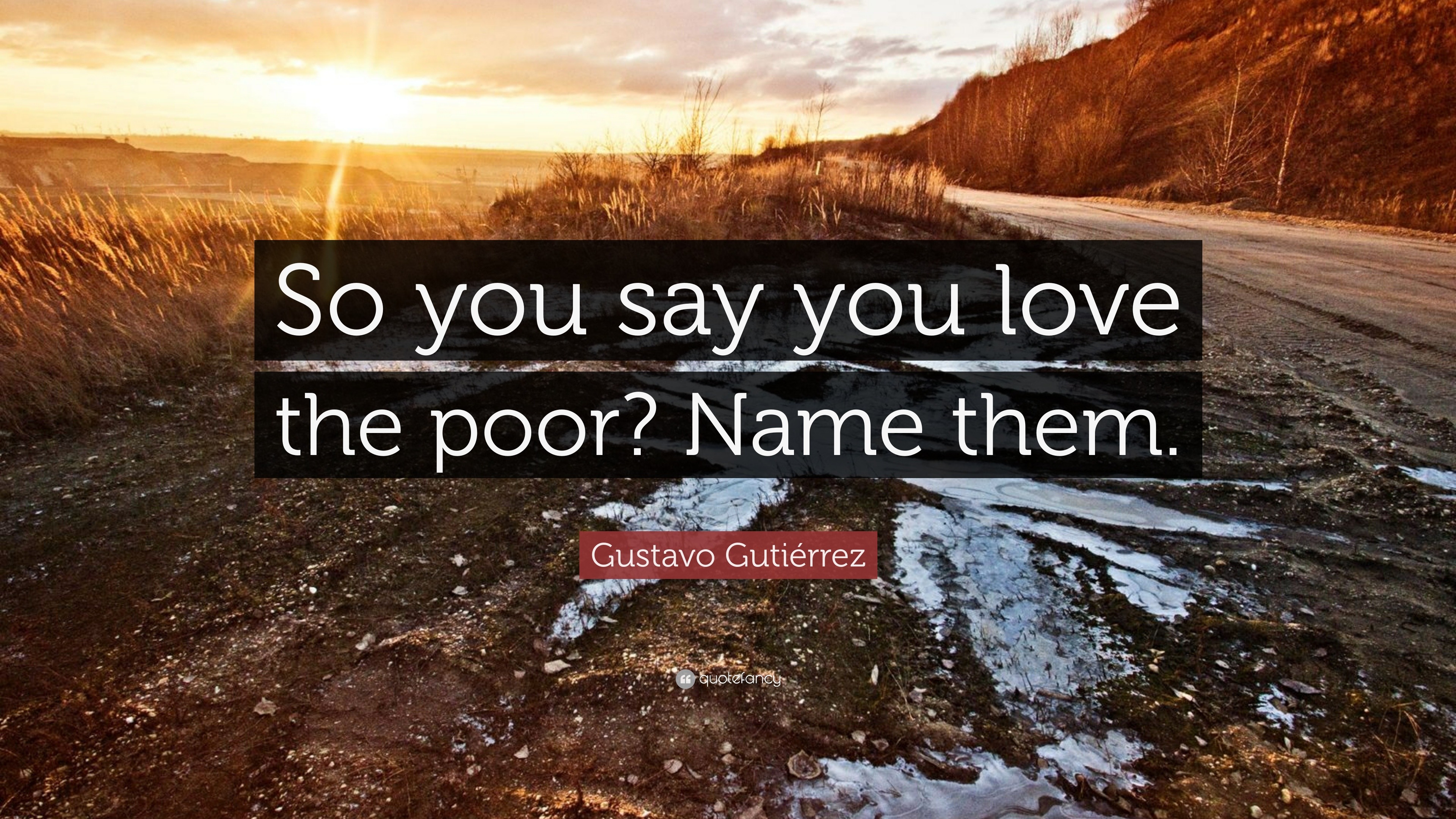
In our reading today what does Jesus say?
Then the King will say to those on his right, ‘Come, you who are blessed by my Father, inherit the Kingdom prepared for you from the creation of the world. 35 For I was hungry, and you fed me. I was thirsty, and you gave me a drink. I was a stranger, and you invited me into your home.36 I was naked, and you gave me clothing. I was sick, and you cared for me. I was in prison, and you visited me.’
37 “Then these righteous ones will reply, ‘Lord, when did we ever see you hungry and feed you? Or thirsty and give you something to drink?38 Or a stranger and show you hospitality? Or naked and give you clothing? 39 When did we ever see you sick or in prison and visit you?’
40 “And the King will say, ‘I tell you the truth, when you did it to one of the least of these my brothers and sisters,[f] you were doing it to me!’
41 “Then the King will turn to those on the left and say, ‘Away with you, you cursed ones, into the eternal fire prepared for the devil and his demons.[g] 42 For I was hungry, and you didn’t feed me. I was thirsty, and you didn’t give me a drink. 43 I was a stranger, and you didn’t invite me into your home. I was naked, and you didn’t give me clothing. I was sick and in prison, and you didn’t visit me.’
44 “Then they will reply, ‘Lord, when did we ever see you hungry or thirsty or a stranger or naked or sick or in prison, and not help you?’
45 “And he will answer, ‘I tell you the truth, when you refused to help the least of these my brothers and sisters, you were refusing to help me.’
When we hear any of these words, we may want to ask the questions;
- What surprises us?
- What do we notice?
- Whats going on?
- What provokes us?
- What makes us think?.. or
- Why doesn’t it? if it doesn’t..
So – what might surprise us about this passage? For me, the following
I notice the complaint from those who gathered who after Jesus made the separation, they said ‘But we didn’t see’ – yet all that was asked by Jesus was to do something – but they didn’t see. Not seeing is equated with refusing.
What else might we notice in the passage. Something else. Notice the language Jesus uses. He doesn’t say that the poor are out there, some where else. The outside of the walls, ‘the other’ – He says ‘ I was hungry, I was thirsty, I was a stranger’. Jesus identifies himself in the poorest, the most vulnerable. He says, when you see the poorest, you see me. When you see, and give, and share, and respect – you give and share and respect me. It makes it the gospel of the weak.
We notice as well that, taking the whole gospel, this is not just about basic human needs, or at least not just the tangiable. Someone hungry and thirsty requires food and water (but how), but also the stranger is felt welcomed. This is about social poverty. As a youth worker, one of the most important things is to always try and talk to the young person who looks like they are on their own, they might be travelling through life on their own, and an opportunity to listen and give them time and space is often most needed. But I was a stranger – says Jesus. A Stranger, in need of community, a stranger in need of belonging. A stranger, outcast. The whole gospel, its not about fixing, its about dignity. To blind Bartimeaus, Jesus doesnt assume that he just wants to see. Jesus asks the question; ‘what do you want me to do for you?’ – Gives the person dignity, respect, and yes is healed – and yes this healing is so key for that person at that time for their whole being. They make the possibility happen that a person can be fully human, can contribute, can have a say in their future.
It is ‘Poverty Sunday’, and in working for Communities together Durham, we think of poverty in three ways, Poverty of resources, Poverty of relationships and poverty of Identity. Now, poverty of resources might be the easiest to think about – yes its food, water, housing, money, employment and getting access to these things – as well as health care. Poverty of Relationship – is about who we are connected with, the support structures, people, family breakdown – and families do breakdown, thats life it happens, but it is who is around to support, listen and help people through these things. Poverty of Identity.; I come from Hartlepool, which is a fabulous place to come from, and fortunately it has middlesbrough just down the road to think of itself better than (Ha), and we all have those places, whether its Ferryhill or Gilesgate, Hartlepool or wherever, its as if the ‘Nothing good can come out of Nazareth’, that Jesus heard about himself, has been an identity curse ever since. But identity is more than town, its being uprooted and having to travel half way across the country as a refugee, its being part of a community or age that is often deriled – like a young person, or someone from the LGBT community. Bullied for being someone, and being true to yourself.
So – we might want to ask ourselves questions? like
what does poverty look like in ____________ ?
What does poverty look like in County Durham?
What is its name?
Poverty could look like a statistic, this might be one way of seeing. Here I have brought copies, you can easily get hold of them, of household population, employment, qualifications of Chilton – but you can do it for anywhere. You can see through the lens of these figures, and you can keep them because i dont need them. Being able to see, doesnt just mean that we read data from surveys. But it is one way.
One of the things the communities together Durham team do, is help churches to see, yes using some data, but also to listen, learn and gather insight into poverty, and then ask the questions, the same as we shared earlier:
- what surprises us about poverty?
- What have we learned?
- what is provoking us?
- what is really going on?
Because it might not always be the best thing to ‘respond’ by doing something practical – even if there is the urge. A compassionate urge. As a team we try and help churches to realise that there is a difference between a foodbank and a food community meal, where many people serve each other and contribute. There is a difference between a coffee morning and a place of welcome, where people are involved and participate, and not just in receipt of service. And, there is nothing wrong with these things – but how do they provoke us – if the foodbank has been growing in the last 5 years. Yet people are still living in complex poverty – what else hasnt been seen?
The first step is to see –
The second is to reflect and ask questions
Questions we also ask as a team are : How might a response promote human dignity, how might the gifts of the person be utilised, how might this response challenge injustice (as we read in our Isaiah reading) – and where is God in the response?
An additional one – is – how might the response build community – build conversation, build participation and help people be involved – like we read with Darren earlier, be involved in decision making in at least something that is with them. They are not just a user.
As a team, we would love to help you in your responses to poverty, to help you see, and help you reflect on this. Theres leaflets at the back (and for the rest of you theres our website http://www.communitiestogetherdurham.org.uk
I then read the story of Lucy’s Flowers, which can be found in Mike Mathers book ‘ Having Nothing, possessing everything’. 
after wards; i recounted a little of my experience of hearing, seeing and being alongside a young woman in the town, who shared of her situation, being homeless, and how it wasn’t just money that helped her, but support, time to meditate and have control, and also to feel like she had choice, some self determination.
Poverty is not out there, we need to see. Human dignity and poverty.
For, I was a stranger, I was naked, I was thirsty, I was in prison.
Thank you.
And that was the end of my sermon this morning.
The personal bit – i didnt share – but reflected on in the car on my way home:
But what do I know about poverty.?
I didn’t grow up on a tough estate. I cant write like Darren McGarvey can.
I went to a decent school, in the midlands. The posh bit of it. well, it wasnt bad…
I didn’t have that much of a challenging family life- though not without its issues. So, am I a fraud?
Well maybe its a realisation that at any point, a decision, a moment of conflict things can change. And though i didn’t say it today in the sermon,events that started from one year ago today, meant that i was about to need to rely on needing to stay in a friends house for 6 months with barely any money. I felt alone, confused, broken. As one friend said at the time, my whole life had fallen apart.
One year on, I count as blessings that decision and those times. I realise how friends, and not money, but care, hospitality and dignity supported and rebuilt me, from a pretty dark place. And yes I did get a new job, underwent counselling, and now have my own new home, and I feel blessed, loved by friends, confident in who i am, at peace, and have gained so much through it all.
I am able to reflect back, and look forward, knowing how blessed i have been, grateful i am. Just one year on and still in the midst. So, poverty isn’t out there. Its so close to each one of us, and decisions I make, we make affect all of this. Sometimes we hide it well. Sometimes we don’t see it, before it hits us. I was a stranger, thirsty and hungry – and so many people gave to me.


 Learning from the Streets
Leave a comment